 Revista ACTA Órgano Oficial de SAGE
Santiago Decotto ID· Rodolfo Pizarro ID
Servicio de Cardiología, Hospital Italiano de Buenos Aires.
Ciudad Autónoma de Buenos Aires. Argentina.
Acta Gastroenterol Latinoam 2026;56(1):7-11
Recibido: 15/03/2026 / Aceptado: 26/03/2026 / Publicado online: 31/03/2026 / https://doi.org/0.52787/agl.v56i1.619

Introducción
La inteligencia artificial (IA) ha experimentado un crecimiento exponencial en los últimos años, impulsado por el desarrollo de algoritmos de aprendizaje automático, el aumento en la capacidad de procesamiento y la creciente disponibilidad de grandes bases de datos clínicos.1-2
Su utilización se ha expandido hacia múltiples áreas de la práctica clínica cotidiana.3-4
Inicialmente asociada al análisis de imágenes o a la automatización de procesos diagnósticos, la IA ha ampliado su campo de acción y hoy interviene también en la generación de modelos predictivos, la estratificación de riesgo y la optimización de decisiones clínicas. En paralelo, la investigación científica ha experimentado una transformación similar: muchas veces la magnitud y complejidad de los datos disponibles superan las posibilidades de los enfoques estadísticos tradicionales. En este contexto, la IA emerge como una herramienta especialmente útil para abordar dicha complejidad. Es así que análisis bibliométricos recientes han documentado un incremento sostenido en el número de publicaciones y citaciones vinculadas a la IA aplicada a la salud en las últimas décadas.1-5
La IA no se limita al análisis de grandes bases de datos, sino que además puede acompañar distintas etapas del proceso de investigación, desde la formulación de hipótesis y el diseño metodológico hasta el análisis de resultados e incluso la redacción científica.6
Sin embargo, su incorporación no está exenta de desafíos. La IA debe entenderse como un recurso complementario, que potencia el trabajo científico, pero no reemplaza el criterio clínico ni el rigor metodológico. Su utilización responsable exige comprender tanto sus fortalezas como sus limitaciones.7-8
En esta breve revisión se analizan las principales aplicaciones de la IA en el diseño, la ejecución y el análisis de estudios clínicos, diferenciando su aporte según el tipo de diseño metodológico y destacando las consideraciones que deben tenerse en cuenta para su implementación adecuada en investigación.
IA en la fase de diseño del estudio de investigación
La IA puede desempeñar un papel relevante desde las etapas iniciales del proceso de investigación, incluso antes del inicio del reclutamiento de pacientes o la recolección de datos. En la fase de diseño, estas herramientas pueden contribuir a optimizar la formulación de hipótesis, la planificación metodológica y la estructuración del protocolo.
En primer lugar, el análisis automatizado de grandes bases de datos clínicos permite identificar patrones, asociaciones preliminares o ciertas tendencias que pueden dar origen a nuevas preguntas de investigación. A diferencia de los enfoques tradicionales, los métodos basados en el aprendizaje automático pueden explorar relaciones complejas o no lineales entre variables, facilitando la generación de nuevas hipótesis basadas en datos.9
Asimismo, la IA puede asistir en la revisión de la literatura científica, permitiendo realizar búsquedas más amplias y estructuradas, identificar artículos relevantes, detectar vacíos de conocimiento y sintetizar la información de manera preliminar.10 Si bien estas herramientas no sustituyen la evaluación crítica del investigador, pueden mejorar la eficiencia y reducir el tiempo necesario para el análisis inicial del tema en cuestión.
En el plano metodológico, la IA también puede emplearse para realizar simulaciones que ayuden a estimar los tamaños muestrales o prever tasas de eventos bajo diferentes supuestos. Estas simulaciones resultan especialmente útiles en los estudios con desenlaces poco frecuentes o en poblaciones heterogéneas, donde la planificación tradicional muestra mayores incertidumbres.11
Por último, en estudios que utilizan historias clínicas electrónicas o registros institucionales, los algoritmos de IA pueden colaborar en la definición operativa de las variables, la estandarización de criterios y la identificación automática de potenciales participantes que cumplan con los criterios de inclusión y exclusión previamente definidos, pudiendo reducir errores derivados de la selección manual de casos.12
IA en ensayos clínicos aleatorizados
En los ensayos clínicos randomizados, la IA puede intervenir en múltiples etapas del estudio. Como se mencionó previamente, los algoritmos aplicados a historias clínicas electrónicas permiten identificar de manera automatizada pacientes potencialmente elegibles según criterios predefinidos, optimizando tiempos y reduciendo sesgos en el reclutamiento.12 Asimismo, los modelos predictivos pueden contribuir a una mejor estratificación basal del riesgo, favoreciendo una asignación más equilibrada de los participantes.
En diseños más complejos, es posible integrar la IA en esquemas de aleatorización adaptativa, un enfoque en el cual la probabilidad de asignación a cada rama se ajusta dinámicamente a lo largo del estudio en función de los resultados interinos acumulados. Este tipo de diseño busca mejorar la eficiencia del ensayo y optimizar la utilización de la información generada durante su desarrollo.13-14 Además, ya existen herramientas automatizadas que pueden facilitar el monitoreo de eventos adversos y la detección temprana de desviaciones del protocolo.
Si bien estas aplicaciones no modifican los principios fundamentales del ensayo clínico, pueden mejorar su eficiencia operativa y la calidad del control de los datos.
IA en estudios observacionales y análisis de grandes bases de datos
En los estudios observacionales, tanto prospectivos como retrospectivos, la IA ofrece herramientas útiles para analizar grandes volúmenes de información.
En cohortes prospectivas, puede utilizarse durante el seguimiento para actualizar estimaciones de riesgo, incorporar nuevas variables a lo largo del tiempo y facilitar la identificación automatizada de eventos clínicos.
En los estudios retrospectivos y en el análisis de grandes bases de datos, ámbito donde probablemente la IA ha tenido mayor impacto, su utilidad radica en la capacidad de organizar y analizar grandes volúmenes de información ya disponible. En los últimos años se han vuelto cada vez más frecuentes los estudios retrospectivos basados en bases de datos nacionales o internacionales, especialmente en países con sistemas de información completamente digitalizados. Muchos de estos trabajos se publican en revistas médicas de alto impacto y aportan evidencia que, en algunos casos, es considerada para la elaboración o actualización de guías de práctica clínica.
En este contexto, los métodos basados en IA permiten revisar miles de registros en poco tiempo, encontrar asociaciones entre múltiples variables y detectar patrones que serían difíciles de identificar manualmente. También pueden ayudar a clasificar pacientes en grupos con características similares y extraer información relevante de las evoluciones médicas o informes.15 Estas herramientas amplían las posibilidades de análisis y pueden generar nuevas hipótesis de investigación. Sin embargo, los resultados obtenidos mediante estos métodos deben interpretarse con cautela y validarse en otras poblaciones para evitar llegar a conclusiones erróneas o asociaciones no reproducibles.
IA en el análisis estadístico y la redacción científica
Además de su papel en el diseño y la recolección de datos, la IA puede cumplir una función importante en la etapa de análisis estadístico, especialmente cuando se trabaja con muchas variables o con información diversa. Estos métodos permiten analizar múltiples factores al mismo tiempo y explorar cómo se relacionan entre sí, lo que facilita la construcción de modelos pronósticos y la integración de datos clínicos, estudios de laboratorio, imágenes o registros electrónicos dentro de un mismo análisis.
Una aplicación particularmente útil es el manejo de datos faltantes (missing data), una situación frecuente en la práctica cotidiana real. En lugar de excluir casos o reemplazar valores de manera simple, los algoritmos pueden estimar la información ausente considerando el conjunto completo de variables disponibles. Esto puede ayudar a reducir sesgos y mejorar la solidez de los resultados.16
Asimismo, las técnicas de agrupamiento (clustering) permiten identificar subgrupos de pacientes con características similares dentro de una misma cohorte. Esto puede ser útil para reconocer distintos perfiles clínicos, comprender mejor la heterogeneidad de ciertas enfermedades y generar nuevas hipótesis de investigación.
Sin embargo, el uso de estas herramientas requiere precaución. Un modelo no debe considerarse válido solo porque funciona bien en los datos con los que fue desarrollado. Es necesario evaluar su desempeño en poblaciones independientes para comprobar que los resultados sean consistentes y aplicables en otros contextos. También es importante evitar que el modelo se ajuste en exceso a la base original, ya que esto puede limitar su utilidad práctica.
Por otro lado, distintas herramientas de IA aplicadas a la redacción científica pueden colaborar en la organización del manuscrito, mejorar la claridad del texto y facilitar su corrección gramatical o traducción a otros idiomas.17
Limitaciones de IA en investigación
Si bien la IA ofrece múltiples ventajas, también presenta limitaciones que deben tenerse en cuenta. En primer lugar, los resultados dependen en gran medida de la calidad de los datos utilizados. Si la información es incompleta, poco representativa o contiene errores, los modelos pueden generar conclusiones poco confiables o difíciles de aplicar en otros contextos.
Además, algunos algoritmos funcionan como “black box”. Esto significa que aunque el modelo pueda generar una predicción o recomendación con alta precisión, el proceso interno mediante el cual llega a esa conclusión no siempre es transparente ni fácilmente comprensible, pudiendo incluso no resultar lógico. Esta falla para interpretar el proceso de análisis puede dificultar la comprensión de los hallazgos, limitar la confianza en los resultados y representar una barrera para su aplicación en la práctica clínica.18 A estas limitaciones técnicas se suman consideraciones éticas relevantes. El uso de grandes bases de datos clínicos exige garantizar la protección de la privacidad y confidencialidad de la información, así como el cumplimiento de los marcos regulatorios vigentes. En la Figura Central se esquematiza el rol actual de la IA en investigación clínica, integrando sus principales aplicaciones metodológicas y los desafíos asociados.
Herramientas de inteligencia artificial aplicadas al proceso de investigación clínica
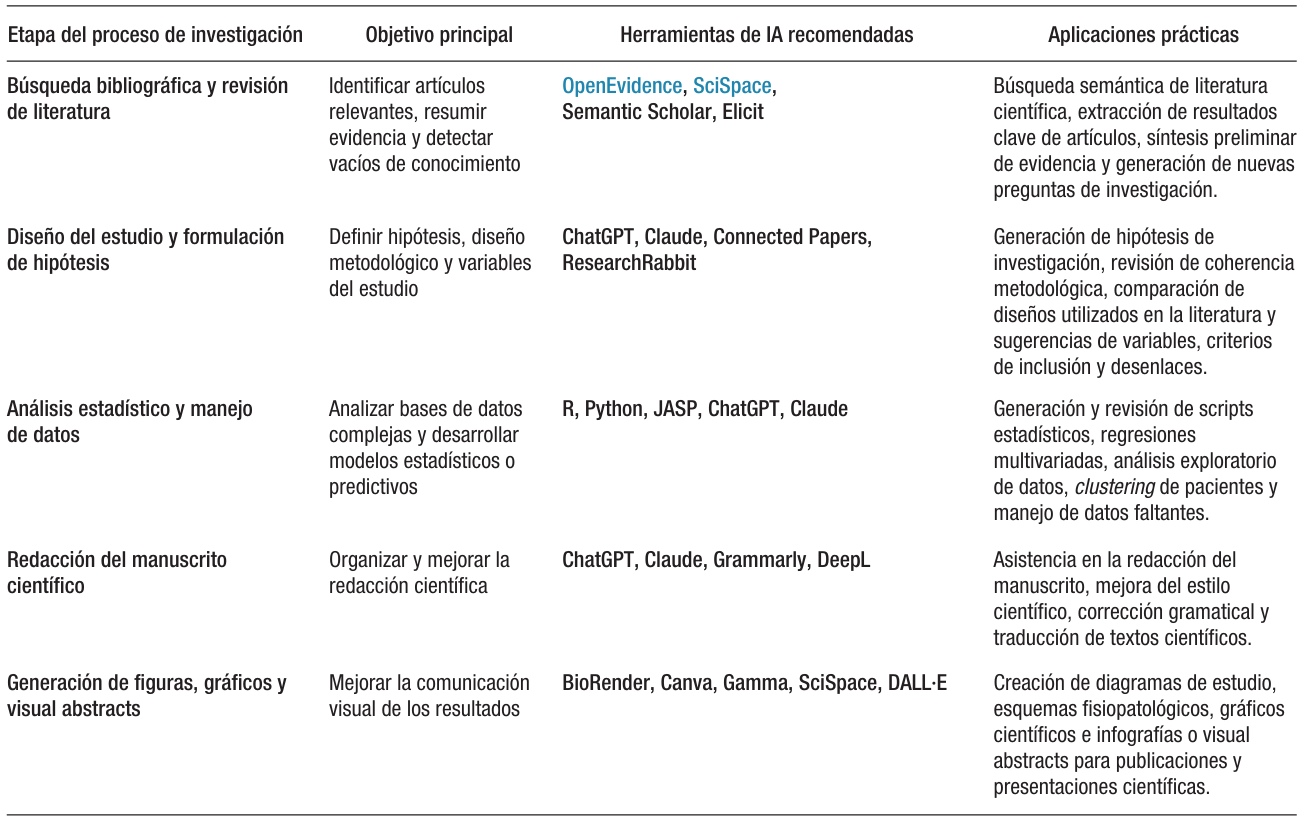
En los últimos años han surgido diversas herramientas basadas en inteligencia artificial que pueden asistir al investigador en las distintas etapas del proceso científico, desde la búsqueda bibliográfica hasta la comunicación visual de los resultados. En la fase inicial, plataformas como OpenEvidence y SciSpace permiten realizar búsquedas semánticas en la literatura científica, resumir artículos y extraer información relevante de forma eficiente, facilitando la identificación de vacíos de conocimiento y la formulación de nuevas preguntas de investigación. Durante el diseño metodológico y la planificación del estudio, modelos de lenguaje como ChatGPT y Claude pueden colaborar en la estructuración de hipótesis, la definición de variables y la revisión de la coherencia del protocolo. En la etapa de análisis de datos, estas herramientas también pueden utilizarse como apoyo para la generación de scripts en entornos estadísticos como R o Python, la exploración de bases de datos complejas y la interpretación preliminar de resultados. Asimismo, en la redacción científica pueden contribuir a mejorar la claridad del texto, organizar el manuscrito y facilitar su traducción a otros idiomas. Finalmente, para la comunicación visual de los hallazgos, plataformas como BioRender, Canva, Gamma o SciSpace permiten generar esquemas, figuras científicas y visual abstracts que facilitan la difusión de los resultados. Si bien estas herramientas pueden aumentar la eficiencia del proceso de investigación, su utilización debe considerarse complementaria al criterio clínico y al rigor metodológico del investigador (Tabla 1).
Figura central. Inteligencia artificial en investigación clínica
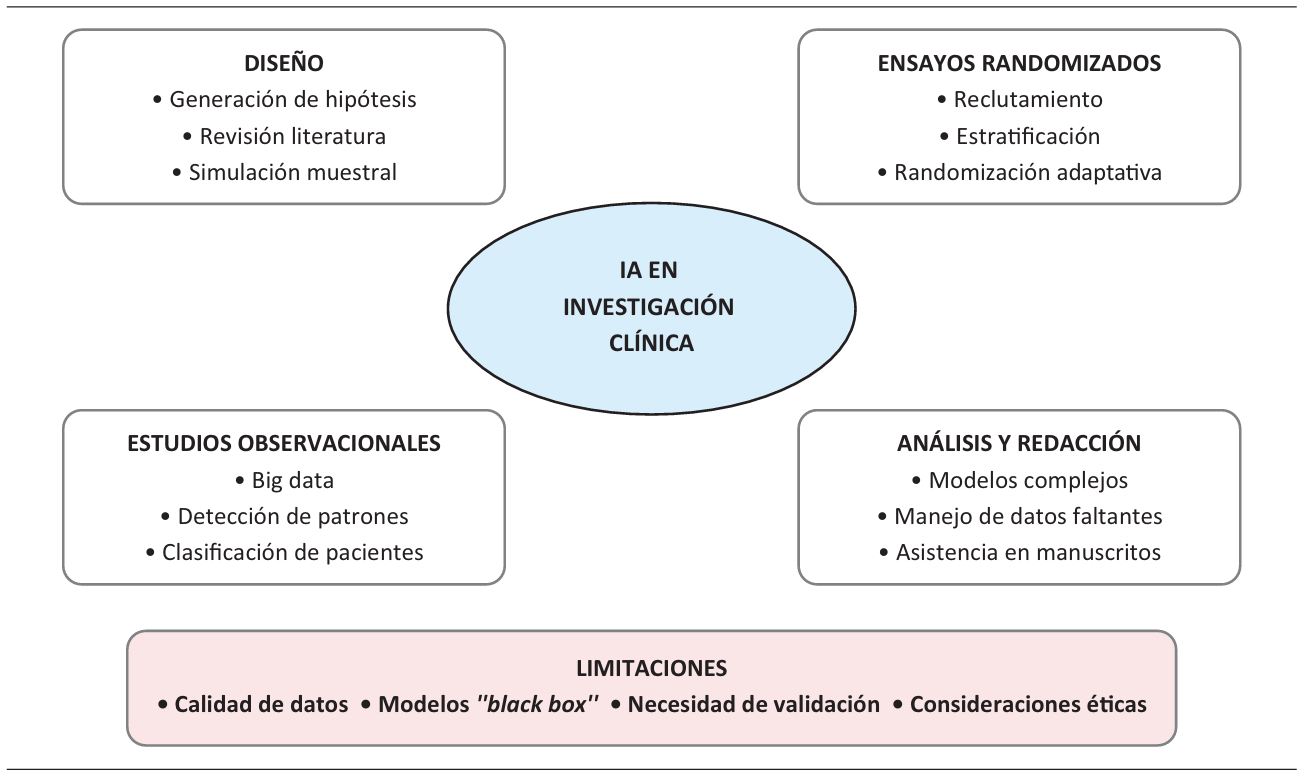
Tabla 1. Herramientas de inteligencia artificial aplicadas a distintas etapas del proceso de investigación clínica
Conclusión
La IA se ha incorporado progresivamente a la investigación clínica y ofrece herramientas útiles para mejorar la eficiencia, el análisis de datos complejos y la producción científica. Su capacidad para procesar grandes volúmenes de información amplía las posibilidades de estudio en distintos diseños metodológicos.
Sin embargo, su verdadero valor radica en su uso responsable y complementario. Cuando se integra con criterio científico y supervisión académica, puede contribuir a fortalecer la calidad de la evidencia sin reemplazar los fundamentos clásicos de la investigación clínica.
Propiedad intelectual. Los autores declaran que los datos y las tablas presentes en el manuscrito son originales y se realizaron en sus instituciones pertenecientes.
Financiamiento. Los autores declaran que no hubo fuentes de financiación externas.
Conflictos de interés. Los autores declaran no tener conflictos de interés en relación con este artículo.
Aviso de derechos de autor

© 2026 Acta Gastroenterológica Latinoamericana. Este es un artículo de acceso abierto publicado bajo los términos de la Licencia Creative Commons Attribution (CC BY-NC-SA 4.0), la cual permite el uso, la distribución y la reproducción de forma no comercial, siempre que se cite al autor y la fuente original.
Cite este artículo como: Decotto S y Pizarro R. Rol de la inteligencia artificial en investigación clínica: aplicaciones metodológicas y desafíos actuales. Acta Gastroenterol Latinoam. 2026;56(1):7-11. https://doi.org/0.52787/agl.v56i1.619
Referencias
- Dalky A, Altawalbih M, Alshanik F, et al. Global Research Trends, Hotspots, Impacts, and Emergence of Artificial Intelligence and Machine Learning in Health and Medicine: A 25-Year Bibliometric Analysis. Healthcare (Basel). 2025 Apr 13;13(8):892.
- Kaul V, Enslin S, Gross SA. History of artificial intelligence in medicine. Gastrointest Endosc 2020;92(4):807-12.
- Hunik L, Uijen AA, Kueper JK, et al. The role and utility of artificial intelligence and machine learning for diagnostic prediction in general practice. Eur J Gen Pract 2026;32(1):2620908.
- Bain AP, Ngai D, Bernard PA. Clinical Decision Support Systems in Generalist Practice: Utilizing Clinical Decision Support Systems Tools to Improve Clinical Decisions and Patient Outcomes. Med Clin North Am 2026;110(2):191-207.
- Lin M, Lin L, Lin L, Lin Z, Yan X. A bibliometric analysis of the advance of artificial intelligence in medicine. Front Med (Lausanne) 2025;12:1504428.
- Sergi CM, Sesso HD. Artificial Intelligence and the future of clinical trials. Contemp Clin Trials Commun 2025;47:101545.
- Raghupathi W, Raghupathi V. Big data in healthcare and medicine revisited design and managerial challenges in the age of artificial intelligence. Health Inf Sci Syst 2026;14(1):38.
- The integration of artificial intelligence into clinical medicine: Trends, challenges, and future directions. Disease-a-Month 2025;71(6):101882.
- Liu R, Rizzo S, Whipple S, et al. Evaluating eligibility criteria of oncology trials using real-world data and AI. Nature 2021;592(7855):629-33.
- Courvoisier DS, Buitrago-Garcia D, Buclin CP, Bürgisser N, Iudici M, Mongin D. Beyond human gold standards: A multimodel framework for automated abstract classification and information extraction. Res Synth Methods 2026;17(2):365-77.
- Arora A, Arora A. Generative adversarial networks and synthetic patient data: current challenges and future perspectives. Future Healthc J 2022;9(2):190-3.
- Ismail A, Al-Zoubi T, El Naqa I, Saeed H. The role of artificial intelligence in hastening time to recruitment in clinical trials. BJR Open 2023;5(1):20220023.
- Ghim J-L, Ahn S. Transforming clinical trials: the emerging roles of large language models. Transl Clin Pharmacol 2023;31(3):131-8.
- Rosenberger WF, Sverdlov O, Hu F. Adaptive randomization for clinical trials. J Biopharm Stat 2012;22(4):719-36.
- Pablo R-GJ, Roberto D-P, Victor S-U, Isabel G-R, Paul C, Elizabeth O-R. Big data in the healthcare system: a synergy with artificial intelligence and blockchain technology. J Integr Bioinform 2021;19(1).
- Liu M, Li S, Yuan H, Ong MEH, Ning Y, Xie F, Saffari SE, Shang Y, Volovici V, Chakraborty B, Liu N. Handling missing values in healthcare data: A systematic review of deep learning-based imputation techniques. Artif Intell Med. 2023 Aug;142:102587.
- Celik SU. Integrating artificial intelligence into scientific writing: a narrative review for clinical and surgical researchers. Am J Surg 2025;250:116657.
- Unveiling the black box: A systematic review of Explainable Artificial Intelligence in medical image analysis. Computational and Structural Biotechnology Journal 2024;24:542-60.
Correspondencia: Santiago Decotto
Correo electrónico: santiago.decotto@hospitalitaliano.org.ar
Acta Gastroenterol Latinoam 2026;56(1):7-11
Role of Artificial Intelligence in Clinical Research: Methodological Applications and Current Challenges
Santiago Decotto ID· Rodolfo Pizarro ID
Department of Cardiology, Hospital Italiano de Buenos Aires.
Ciudad Autónoma de Buenos Aires. Argentina.
Acta Gastroenterol Latinoam 2026;56(1):12-16
Received: 15/03/2026 / Accepted: 26/03/2026 / Published online: 31/03/2026 / https://doi.org/0.52787/agl.v56i1.619
Introduction
Artificial intelligence (AI) has experienced exponential growth in recent years, driven by the development of machine learning algorithms, increased processing capacity, and the growing availability of large clinical databases.1-2 Its use has expanded into multiple areas of everyday clinical practice.3-4
Initially associated with image analysis or the automation of diagnostic processes, AI has broadened its scope and is now also involved in generating predictive models, risk stratification, and optimizing clinical decision. In parallel, scientific research has undergone a similar transformation: often, the magnitude and complexity of available data exceed the capabilities of traditional statistical approaches. In this context, AI emerges as a particularly useful tool for addressing this complexity. Accordingly, recent bibliometric analyses have documented a sustained increase in the number of publications and citations related to AI applied to healthcare in recent decades.1-5
AI is not limited to the analysis of large datasets, but can also support different stages of the research process, from hypothesis generation and methodological design to results analysis and even scientific writing.6
However, its incorporation is not without challenges. AI should be understood as a complementary resource that enhances scientific work, but does not replace clinical judgment or methodological rigor. Its responsible use requires understanding both its strengths and its limitations.7-8
This brief review analyzes the main applications of AI in the design, execution, and analysis of clinical studies, distinguishing its contribution according to the type of methodological design and highlighting the considerations that must be taken into account for its appropriate implementation in research.
AI in the Research Study Design Phase
AI can play a relevant role from the earliest stages of the research process, even before patient recruitment or data collection begins. In the design phase, these tools can help optimize hypothesis formulation, methodological planning, and protocol structuring.
First, the automated analysis of large clinical databases allows for the identification of patterns, preliminary associations, or certain trends that can lead to new research questions. Unlike traditional approaches, machine learning–based methods can explore complex or non-linear relationships between variables, facilitating the generation of new data-driven hypotheses.9
Likewise, AI can assist in the review of the scientific literature, enabling broader and more structured searches, identifying relevant articles, detecting knowledge gaps, and synthesizing information in a preliminary way.10 While these tools do not replace the researcher’s critical appraisal, they can improve efficiency and reduce the time required for the initial analysis of a given topic.
Methodologically, AI can also be used to perform simulations that help estimate sample sizes or predict event rates under different assumptions. These simulations are particularly useful in studies with infrequent outcomes or in heterogeneous populations, where traditional planning involves greater uncertainties.11
Finally, in studies that use electronic health records or institutional registries, AI algorithms can assist in the operational definition of variables, the standardization of criteria, and the automated identification of potential participants who meet the predefined inclusion and exclusion criteria, potentially reducing errors resulting from manual case selection.12
AI in Randomized Clinical Trials
In randomized clinical trials, AI can be used at multiple stages of the study. As mentioned previously, algorithms applied to electronic health records allow for the automated identification of potentially eligible patients based on predefined criteria, optimizing time and reducing recruitment bias.12 Predictive models can also contribute to better baseline risk stratification, promoting a more balanced allocation of participants.
In more complex designs, AI can be integrated into adaptive randomization schemes, an approach in which the probability of assignment to each arm is dynamically adjusted throughout the study based on accumulated interim results. This type of design aims to improve trial efficiency and optimize the use of information generated during its development.13-14 Furthermore, automated tools already exist that can facilitate the monitoring of adverse events and the early detection of protocol deviations.
While these applications do not modify the fundamental principles of clinical trials, they can improve operational efficiency and the quality of data control.
AI in Observational Studies and Big Data Analysis
In observational studies, both prospective and retrospective, AI offers useful tools for analyzing large volumes of information.
In prospective cohorts, it can be used during follow-up to update risk estimates, incorporate new variables over time, and facilitate the automated identification of clinical events.
In retrospective studies and large database analyses, areas where AI has likely had the greatest impact, its usefulness lies in its ability to organize and analyze large volumes of already available information. In recent years, retrospective studies based on national or international databases have become increasingly common, particularly in countries with fully digitized information systems. Many of these studies are published in high-impact medical journals and provide evidence that, in some cases, is considered for the development or updating of clinical practice guidelines.
In this context, AI-based methods allow for the review of thousands of records in a short time, the identification of associations between multiple variables, and the detection of patterns that would be difficult to recognize manually. They can also help classify patients into groups with similar characteristics and extract relevant information from clinical records or reports.15 These tools expand the possibilities for analysis and can generate new research hypotheses. However, the results obtained using these methods should be interpreted with caution and validated in other populations to avoid drawing erroneous conclusions or identifying non-reproducible associations.
AI in Statistical Analysis and Scientific Writing
In addition to its role in study design and data collection, AI can play a significant role in the statistical analysis stage, especially when working with many variables or diverse information. These methods allow for the simultaneous analysis of multiple factors and the exploration of their interrelationships, facilitating the development of prognostic models and the integration of clinical data, laboratory results, imaging, or electronic records within a single analysis.
One particularly useful application is the handling of missing data, a common issue in real-world practice. Instead of simply excluding cases or replacing values, algorithms can estimate missing information by considering the full set of available variables. This can help reduce bias and improve the robustness of the results.16
Additionally, clustering techniques allow for the identification of subgroups of patients with similar characteristics within a given cohort. This can be useful for recognizing different clinical profiles, better understanding the heterogeneity of certain diseases, and generating new research hypotheses.
However, the use of these tools requires caution. A model should not be considered valid simply because it performs well on the data used to develop it. Its performance must be evaluated in independent populations to ensure that results are consistent and applicable in other settings. It is also important to avoid overfitting to the original dataset, as this may limit its practical utility.
On the other hand, various AI-based tools applied to scientific writing can assist in organizing the manuscript, improving textual clarity, and facilitating grammatical correction or translation into other languages.17
Limitations of AI in Research
Although AI offers multiple advantages, it also presents limitations that must be considered. First, the results depend heavily on the quality of the data used. If the information is incomplete, unrepresentative, or contains errors, models may generate unreliable conclusions or findings that are difficult to apply in other contexts.
Additionally, some algorithms function as “black boxes.” This means that although the model may generate a highly accurate prediction or recommendation, the internal process by which it reaches that conclusion is not always transparent or easily understandable, and may even be illogical. This failure to interpret the analysis process can hinder the understanding of findings, limit confidence in the results, and represent a barrier to their application in clinical practice.18
Beyond these technical limitations, there are relevant ethical considerations. The use of large clinical databases requires ensuring the protection of privacy and data confidentiality of information, as well as compliance with current regulatory frameworks. The Central Figure illustrates the current role of AI in clinical research, integrating its main methodological applications and associated challenges.
Artificial Intelligence Tools Applied to the Clinical Research Process
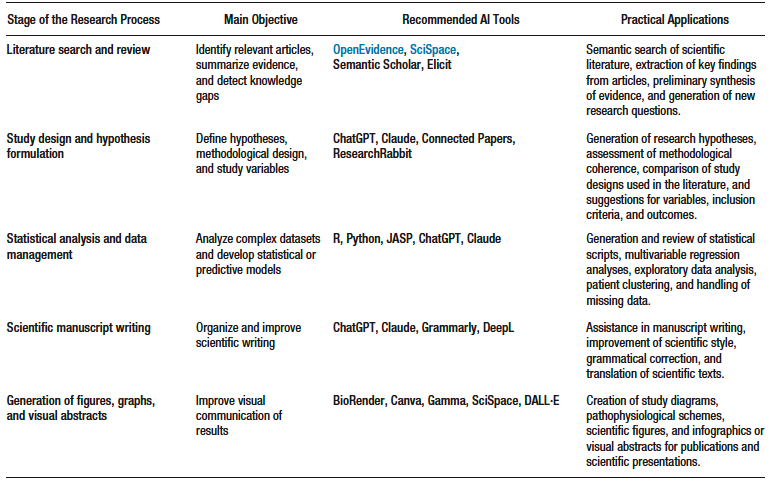
In recent years, various AI-based tools have emerged that can assist researchers at different stages of the scientific process, from literature search to the visual communication of results. In the initial phase, platforms such as OpenEvidence and SciSpace enable semantic searches of the scientific literature, summarization of articles, and efficient extraction of relevant information, facilitating the identification of knowledge gaps and the formulation of new research questions.
During methodological design and study planning, language models such as ChatGPT and Claude can assist in structuring hypotheses, defining variables, and reviewing the coherence of the protocol. In the data analysis stage, these tools can also be used to support script generation in statistical environments such as R or Python, the exploration of complex datasets, and the preliminary interpretation of results.
Similarly, in scientific writing, they can help improve text clarity, organize the manuscript, and facilitate translation into other languages. Finally, for the visual communication of findings, platforms such as BioRender, Canva, Gamma, or SciSpace allow the creation of diagrams, scientific figures, and visual abstracts that enhance the dissemination of results.
Although these tools can increase the efficiency of the research process, their use should be considered complementary to the researcher’s clinical judgment and methodological rigor (Table 1).
Central Figure. Artificial Intelligence in Clinical Research
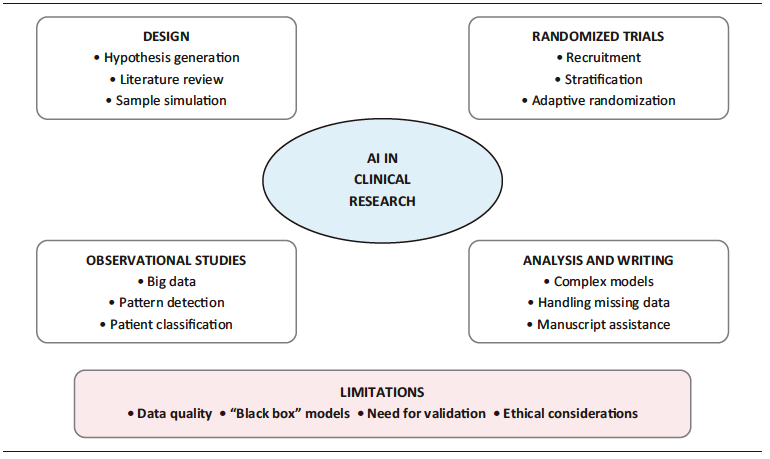
Table 1. Artificial intelligence tools applied to different stages of the clinical research process
Conclusion
AI has been progressively incorporated into clinical research and offers useful tools to improve efficiency, the analysis of complex data, and scientific production. Its ability to process large volumes of information expands research possibilities across different methodological designs.
However, its true value lies in its responsible and complementary use. When integrated with scientific judgment and academic oversight, it can help strengthen the quality of evidence without replacing the fundamental principles of clinical research.
Intellectual property. The authors declare that the data, figures and tables in this article are original and were carried out at their institutions.
Funding. The authors declare that there were no external sources of funding.
Conflict of interest. The authors declare that they have no conflicts of interest in relation to this article.
Copyright
© 2026 Acta Gastroenterológica latinoamericana. This is an open-access article released under the terms of the Creative Commons Attribution (CC BY-NC-SA 4.0) license, which allows non-commercial use, distribution, and reproduction, provided the original author and source are acknowledged.
Cite this article as: Decotto S y Pizarro R. Role of Artificial Intelligence in Clinical Research: Methodological Applications and Current Challenges. 2026;56(1):12-16. https://doi.org/0.52787/agl.v56i1.619
References
- Dalky A, Altawalbih M, Alshanik F, et al. Global Research Trends, Hotspots, Impacts, and Emergence of Artificial Intelligence and Machine Learning in Health and Medicine: A 25-Year Bibliometric Analysis. Healthcare (Basel). 2025 Apr 13;13(8):892.
- Kaul V, Enslin S, Gross SA. History of artificial intelligence in medicine. Gastrointest Endosc 2020;92(4):807-12.
- Hunik L, Uijen AA, Kueper JK, et al. The role and utility of artificial intelligence and machine learning for diagnostic prediction in general practice. Eur J Gen Pract 2026;32(1):2620908.
- Bain AP, Ngai D, Bernard PA. Clinical Decision Support Systems in Generalist Practice: Utilizing Clinical Decision Support Systems Tools to Improve Clinical Decisions and Patient Outcomes. Med Clin North Am 2026;110(2):191-207.
- Lin M, Lin L, Lin L, Lin Z, Yan X. A bibliometric analysis of the advance of artificial intelligence in medicine. Front Med (Lausanne) 2025;12:1504428.
- Sergi CM, Sesso HD. Artificial Intelligence and the future of clinical trials. Contemp Clin Trials Commun 2025;47:101545.
- Raghupathi W, Raghupathi V. Big data in healthcare and medicine revisited design and managerial challenges in the age of artificial intelligence. Health Inf Sci Syst 2026;14(1):38.
- The integration of artificial intelligence into clinical medicine: Trends, challenges, and future directions. Disease-a-Month 2025;71(6):101882.
- Liu R, Rizzo S, Whipple S, et al. Evaluating eligibility criteria of oncology trials using real-world data and AI. Nature 2021;592(7855):629-33.
- Courvoisier DS, Buitrago-Garcia D, Buclin CP, Bürgisser N, Iudici M, Mongin D. Beyond human gold standards: A multimodel framework for automated abstract classification and information extraction. Res Synth Methods 2026;17(2):365-77.
- Arora A, Arora A. Generative adversarial networks and synthetic patient data: current challenges and future perspectives. Future Healthc J 2022;9(2):190-3.
- Ismail A, Al-Zoubi T, El Naqa I, Saeed H. The role of artificial intelligence in hastening time to recruitment in clinical trials. BJR Open 2023;5(1):20220023.
- Ghim J-L, Ahn S. Transforming clinical trials: the emerging roles of large language models. Transl Clin Pharmacol 2023;31(3):131-8.
- Rosenberger WF, Sverdlov O, Hu F. Adaptive randomization for clinical trials. J Biopharm Stat 2012;22(4):719-36.
- Pablo R-GJ, Roberto D-P, Victor S-U, Isabel G-R, Paul C, Elizabeth O-R. Big data in the healthcare system: a synergy with artificial intelligence and blockchain technology. J Integr Bioinform 2021;19(1).
- Liu M, Li S, Yuan H, Ong MEH, Ning Y, Xie F, Saffari SE, Shang Y, Volovici V, Chakraborty B, Liu N. Handling missing values in healthcare data: A systematic review of deep learning-based imputation techniques. Artif Intell Med. 2023 Aug;142:102587.
- Celik SU. Integrating artificial intelligence into scientific writing: a narrative review for clinical and surgical researchers. Am J Surg 2025;250:116657.
- Unveiling the black box: A systematic review of Explainable Artificial Intelligence in medical image analysis. Computational and Structural Biotechnology Journal 2024;24:542-60.
Correspondence: Santiago Decotto
Email: santiago.decotto@hospitalitaliano.org.ar
Acta Gastroenterol Latinoam 2026;56(1):12-16